
Making Token Distributions Fair: A Structural Approach
How to level the playing field for investors and insiders alike.

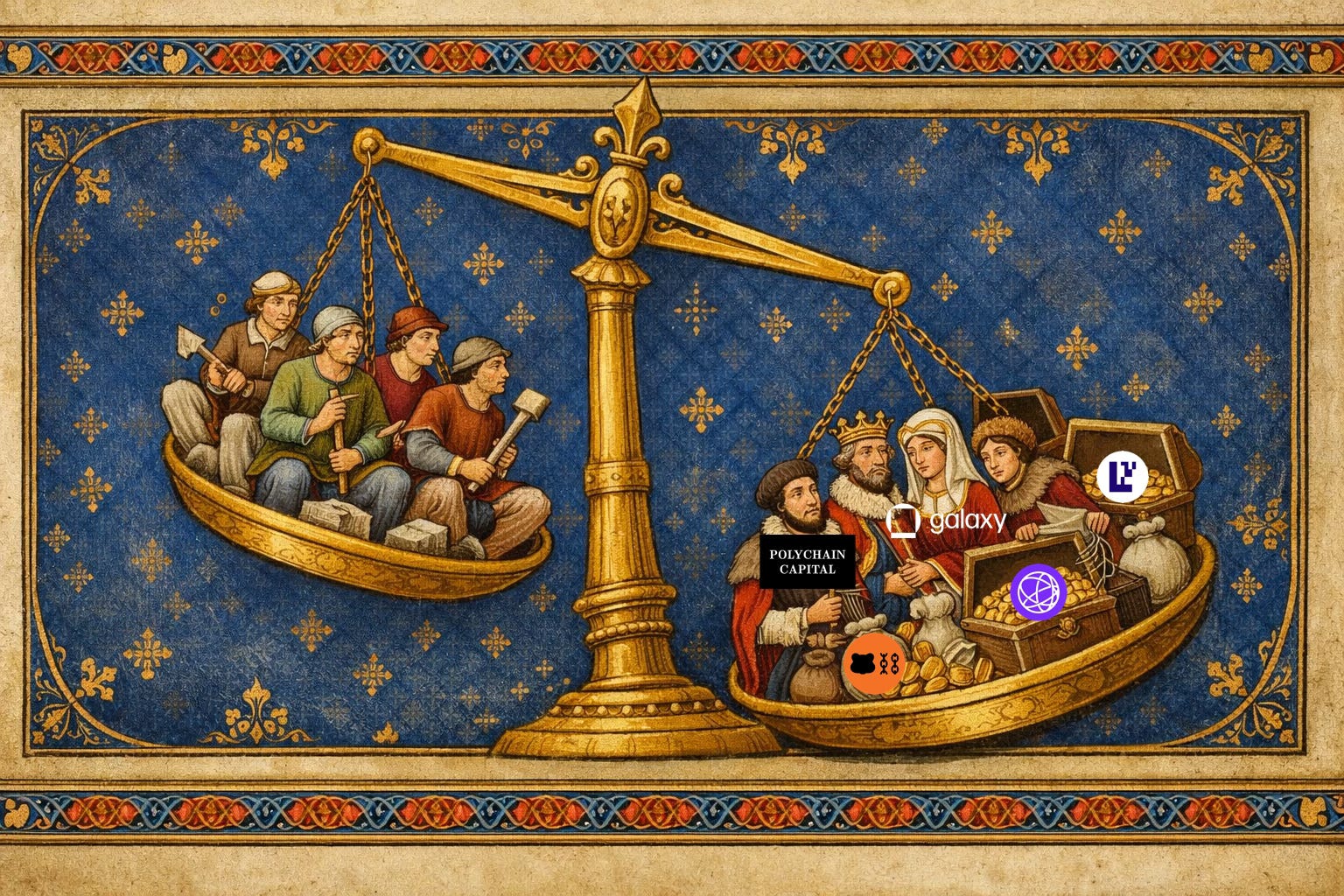
Token distribution is one of the most consequential decisions a founding team makes. After processing over $1B in transactions across hundreds of tokens, I’ve seen nearly every outcome. The standard model allocates tokens directly to team members and investors, subject to vesting schedules and lockups. This approach mirrors traditional equity compensation but introduces structural asymmetries that disadvantage the people who build projects, the employees.
This article proposes an alternative framework that treats token distributions more like dividends than direct holdings, centralizing liquidation decisions to ensure fair execution for all stakeholders.
The Execution Gap
When tokens unlock, all holders theoretically gain the same right to sell. In practice, execution quality varies dramatically by holder sophistication.
We can consider a typical unlock event one year after token subscription paperwork has been executed. A venture fund with a material position will have prepared months in advance by coordinating OTC relationships, block trade counterparties lined up, selecting their execution preferences to minimize slippage. The moment tokens become transferable, their sell order executes at or near the prevailing price.
An employee with a smaller allocation faces a different reality. They may not track unlock times precisely. They lack OTC relationships and sophisticated knowledge of the market. When they attempt to sell through a retail interface, they discover that institutional sellers have already moved the market. The employee—who contributed years of work to the project’s success—receives materially worse execution than the investor who contributed capital.
This is not a matter of sophistication being rewarded. It is a structural disadvantage baked into the distribution model.
Observed Failure Modes
Recent token launches have revealed several recurring patterns that exacerbate these asymmetries.
Staking Reward Extraction — Some networks allow locked tokens to be staked, generating liquid rewards that can be sold immediately. An investor with locked tokens extracts value continuously while their principal remains nominally restricted. Celestia provides a concrete example: Polychain Capital invested approximately $20 million in Celestia’s Series A and B funding rounds, and despite their tokens remaining locked, on-chain analysts estimate the firm sold over $240 million worth of TIA through staking rewards alone—a return exceeding twelve times their initial investment without selling a single locked token (The Block, Unchained). Celestia has since addressed this dynamic: the foundation repurchased Polychain’s remaining stake for $62.5 million in July 2025, and the forthcoming “Lotus” mainnet upgrade will lock staking rewards proportionally to the vesting schedule of underlying tokens (Celestia). Employees with smaller allocations, even if aware of this mechanism, lack the infrastructure to execute similar strategies at scale.
Undisclosed Liquidity Mechanisms — Documentation governing token restrictions has, in some cases, been updated shortly before or after token launch to permit previously undisclosed liquidity pathways for early investors. EigenLayer illustrates the issue: when EIGEN tokens became transferable in late September 2024, community members discovered that early investors with nominally locked allocations could stake those tokens and sell the resulting rewards immediately. On-chain analyst TardFiWhale.eth noted that EigenLayer’s documentation had been updated shortly before launch to permit this practice, but the information did not appear in archived versions from just two weeks prior (CoinDesk, Protos). Of the 130 million EIGEN tokens staked at launch, approximately 70 million belonged to early investors earning tradable rewards while their principal remained locked. When these updates occur without adequate notice, later participants—including employees—make decisions based on incomplete information about actual circulating supply and selling pressure.
Asymmetric Exit Rights — Investment agreements occasionally include provisions unavailable to other stakeholders. Berachain’s Series B financing revealed one such arrangement: investigative reporting by Unchained uncovered a supplementary agreement between Berachain and Nova Digital Fund (a subsidiary of Brevan Howard) granting Nova the right to demand a full refund of its $25 million investment in cash at any time within one year of the token generation event (Unchained, Bitget News). BERA launched at approximately $15 in February 2025 and subsequently declined over 90%. Nova held what amounted to a put option: upside exposure if the token appreciated, with principal protection if it did not. Other Series B investors, including Framework Ventures, stated publicly they were unaware of the arrangement (Bitget News). Berachain’s co-founder later acknowledged the project had sold too much supply to VCs and announced efforts to buy back tokens to reduce community dilution (Crypto.news). Side letters granting put options, refund rights, or preferential liquidation terms create a two-tier system where certain holders bear less downside risk than employees or community members holding the same asset.
These patterns share a common thread: they advantage holders with legal sophistication and negotiating leverage over those whose primary contribution was building the product.
A Structural Alternative
Rather than distributing tokens directly to individuals, founders can structure allocations to flow through an entity—typically the offshore foundation that issues the tokens, or a dedicated vehicle controlled by the operating company.
Under this model:
Token Custody. The entity holds tokens on behalf of investors and team members. Individual beneficiaries have contractual rights to the economic value of their allocation, but not direct possession of tokens.
Liquidation Authority. A board, committee, or defined governance process determines when and how tokens are sold. This decision can be triggered by periodic schedules, supermajority votes, or board resolution. An independent committee designated specifically for liquidation decisions can provide additional oversight.
Execution Standards. The governing documents mandate professional execution through a designated market maker employing strategies designed to minimize market impact. A 30-day time-weighted average price (TWAP) execution distributes selling pressure across weeks rather than concentrating it at unlock moments. This prevents scenarios where a majority holder dumps on an AMM or illiquid market and tanks the price for everyone else.
Cash Distribution. Proceeds from token sales are distributed to beneficiaries as dividends, proportional to their allocation. The employee and the venture fund receive the same per-token execution price.
Implementation
This structure should be established at formation, not retrofitted after token issuance. The key implementation points:
Subscription Agreements — Investment documents—Token purchase agreements, and similar instruments—must incorporate the entity-based structure explicitly. The subscription agreement is the appropriate vehicle to mandate execution standards such as TWAP requirements and market maker designation. Any onshore entity purchasing rights to tokens should have these provisions in its purchase agreement.
Entity Structure — The typical configuration involves an offshore foundation that brings the onshore operating company, employees, and investors on directly. This consolidates custody and liquidation authority in a single governed vehicle.
Divergent Liquidity Needs — Investors with fund lifecycles may prefer earlier liquidity than employees with longer time horizons. The governance process should account for these tensions through pre-determined periodic selling schedules or percentage-based voting thresholds set by the issuer.
Hardship Provisions — Some beneficiaries may face genuine liquidity needs before scheduled distributions. The structure can accommodate hardship provisions, though these should be narrow and subject to board approval to prevent erosion of the collective benefit.
Worked Example
Consider a project structured under the conventional model versus the entity-based alternative.
Conventional Structure — A network launches with 20% of tokens allocated to early investors and 20% to team members. One year post-launch, a cliff unlock releases a substantial portion of supply. Institutional investors, having prepared OTC arrangements, execute sales at $15 per token. Over the following weeks, continued selling pressure drives the price to $8. Team members who sell during this period—lacking OTC access and competing with professional desks—realize an average of $9 per token.
The investor received 67% more per token than the employee for the identical asset.
Entity-Based Structure — The same network holds all investor and team allocations in a foundation-controlled vehicle. One year post-launch, the board authorizes a partial liquidation representing 10% of held tokens. A designated market maker executes a 30-day TWAP, achieving an average sale price of $12 per token across all tranches. Proceeds are distributed to all beneficiaries proportionally.
Every stakeholder—investor and employee alike—receives $12 per token. The execution gap disappears. Funds are distributed at the same time.
Regulatory Considerations
This structure increases centralization of control over token supply, which may affect securities analysis in certain jurisdictions. Founders should consult counsel regarding whether concentrated liquidation authority strengthens or complicates arguments for decentralization. The trade-offs will vary by jurisdiction and specific token economics. A dedicated section addressing adverse regulatory factors should be part of any implementation analysis.
Conclusion
The current token distribution paradigm optimizes for simplicity at the cost of fairness. Centralizing custody and liquidation authority in a governed entity eliminates the execution gap that systematically disadvantages employees.
This is not a radical departure from traditional corporate practice. In conventional equity structures, employees do not individually negotiate their exit timing; liquidity events occur at the company level, with proceeds distributed according to ownership. Token networks have no inherent reason to diverge from this model.
For founders designing tokenomics today, the question is straightforward: should execution quality depend on individual sophistication, or should the structure itself guarantee fair treatment? The entity-based model answers that question in favor of the people who build.