
Your Moat is Not Moat
How to think about your moat in a world where exchanges can ship

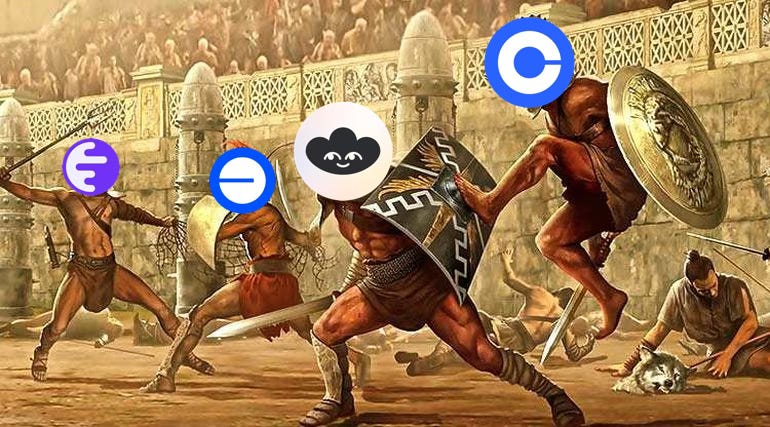
Prior to 2025, exchanges did one thing. They were centralized and therefore their capabilities were limited. They could only launch products that fit on top of this model and that meant maybe they could do a futures product, maybe they could do some yield products. Now the landscape has shifted, there is enough talent consolidated in major exchanges, the exchanges have defi interfaces and they can ship fast. We saw what Coinbase did with the Base wallet, the decentralized interface. They locked everyone in a room and got it shipped in weeks. They even launched Base, their own chain with a vibrant ecosystem. Fresh entrepreneurs now want to build on Base for the Coinbase brand association.
When exchanges can ship like this and they have the tier 1 brand cachet, their total addressable market expands and they attract innovators. Now you are in the wolfs den, can you expand to be bigger than the exchange or will you be forever a subset of their market?
The competitive landscape for crypto startups has fundamentally changed. The question is no longer what exchanges won’t do—it’s what they can’t do. That list is getting shorter by the quarter.
A New Frontier
Let’s review what occurred in the past eighteen months.
Coinbase launched Base, their chain, in August 2023. A publicly traded, SEC-scrutinized company now operates one of the largest L2 blockchains by transaction volume. Kraken announced Ink, their own L2, launching in early 2025. Binance has been running BNB Chain since 2020. The “exchanges don’t touch L1s” thesis is dead.
The Coinbase Wallet now interfaces directly with DeFi. Their Bitcoin-backed loans product hit over $1 billion in originations by October 2025, running through Morpho on Base. They wrapped Bitcoin as cbBTC. They launched a card that lets you spend crypto at merchants. The “exchanges can’t do DeFi” thesis is also dead.
The regulatory moat—the idea that compliance complexity would keep large players out of innovative product lines—evaporated when the largest regulated exchange in America started running a blockchain and offering permissionless lending.
Operating in an increasingly competitive environment
In advance of the next few paragraphs, I want everyone named to know I love them, just applying a sober, critical lens here. Please forgive me.
The startup graveyard is filling up with companies that were “features, not products.”
Privy built embedded wallets that let users sign up with email and have an embedded wallet created behind the scenes. Elegant technology. Stripe acquired them in June 2025 for an undisclosed amount. Privy had raised $41 million. They powered 75 million accounts. And they became a feature in Stripe’s stack.
Farcaster raised $150 million from Paradigm and a16z in May 2024 at nearly a $1 billion valuation. By late 2025, monthly active users had dropped from a peak of 80,000 to under 20,000. The team pivoted from “social-first” to “wallet-first” after they’d spent four and a half years competing with centralized platforms without success. In January 2026, Neynar, and application layer solution acquired them. SocialFi, even with $180 million in total funding and a wallet integration, was a feature.
After a legendary run and returning all capital to investors, Dan Romero, Farcaster’s founder, put it bluntly: “We tried for 4.5 years to put social first, but it didn’t work.”
Lens Protocol tells a similar story. Built by the Aave team, Lens raised $15 million in 2023 and another $31 million in late 2024. The thesis was compelling: a decentralized social graph where users own their content and connections. But usage collapsed. Daily active users dropped from 42,000 at peak to around 8,000. New signups cratered 99%—from 37,000 profiles per day during hype peaks to barely 150. When Farcaster's DEGEN token drove engagement, Lens rushed to copy the model with BONSAI. By late 2023, crypto Twitter had stopped talking about Lens entirely. Nearly $50 million in funding, backing from top-tier investors, and a team that had already built one of DeFi's most successful protocols—none of it mattered. The social graph was a feature waiting for a platform that never came.
The pattern is clear. If what you’re building can be replicated by a team at Coinbase, Kraken, or Binance in a quarter, you don’t have a company. You have a roadmap feature.
What’s Left?
This brings us to the uncomfortable question: what moats actually exist for crypto startups now?
Network effects that compound. The exchanges have users, but they don’t have every type of network. Liquidity networks (Uniswap), developer ecosystems built around specific tooling, and specialized communities still matter. The key word is “compound”—if your network doesn’t get meaningfully stronger with each new participant, an exchange can bootstrap a competing one with their existing user base.
Product lines they haven’t imagined. This is harder than it sounds. The exchanges have large, competent product teams now. They’re watching the same Twitter feeds you are, they are feeling the same market fluctuations you are. Occasionally something emerges that’s genuinely orthogonal to their roadmap. Prediction markets were this for a while, until Coinbase announced their acquisition of The Clearing Company. The window between “novel concept” and “Coinbase is building this” is measured in months.
Technological innovation that’s hard to replicate. In an open-source ecosystem, this is tricky. Your code is public. Your architecture is documentable. The advantage has to come from something deeper—proprietary data sets, hardware integrations, or cryptographic research that takes years to replicate. Zero-knowledge proofs were a genuine moat for a while. Now every major exchange has a ZK team.
Terminal velocity before they notice. If you can reach escape velocity before an exchange decides to compete, you might survive through sheer momentum. This requires both speed and capital efficiency. You need to be growing fast enough that by the time Coinbase ships a competing product, your users are too embedded to switch. Hyperliquid pulled this off with perpetuals. Most don’t.
The Open Source Problem
Here’s the uncomfortable truth about technological moats in crypto: the culture of the industry works against them.
Open source is a feature, not a bug—it builds trust, enables composability, and attracts developers. But it also means your innovations are available to anyone with a GitHub account and a product team. The exchanges have both.
When you ship a novel mechanism, you’re effectively publishing a research paper that Coinbase’s team will read, improve upon, and ship with better distribution. Your six-month head start becomes a rounding error against their 110 million verified users.
This doesn’t mean technological innovation is worthless. It means the innovation has to be deep enough that copying it requires more than reading your code. It has to require the organizational knowledge, the iteration cycles, the hard-won lessons that don’t make it into the repository.
How To Win
For founders, the calculus has changed. The question isn’t “Is this a good idea?” It’s a two-part test:
Can Coinbase, Kraken, or Binance build this with their existing resources, user base, and regulatory posture?
If yes, can you reach terminal velocity before they do?
If the answer to the first question is yes and the answer to the second is “probably not,” you’re building a feature. Features get acquired at a discount to their potential, or they get copied and die.
The path forward is narrower than it was. The exchanges have capital, users, regulatory relationships, and now—critically—the willingness to ship fast and compete in spaces they previously avoided.
This means focusing on networks the exchanges can’t bootstrap? What is your competitive edge in the market and how can you get access to business opportunities exchanges are too big to create
?
Sharp analysis of how moat dynamics shift when distributors actualy become builders. The two-part test of 'can they build it' and 'will you reach terminal velocity first' is critical reframing most founders miss. Saw this exact pattern in fintech where banks started shipping features that took startups years. The open source paradox is brutal but the answerisnt defensiveness, its finding network effects exchanges structurally cant bootstrap.